
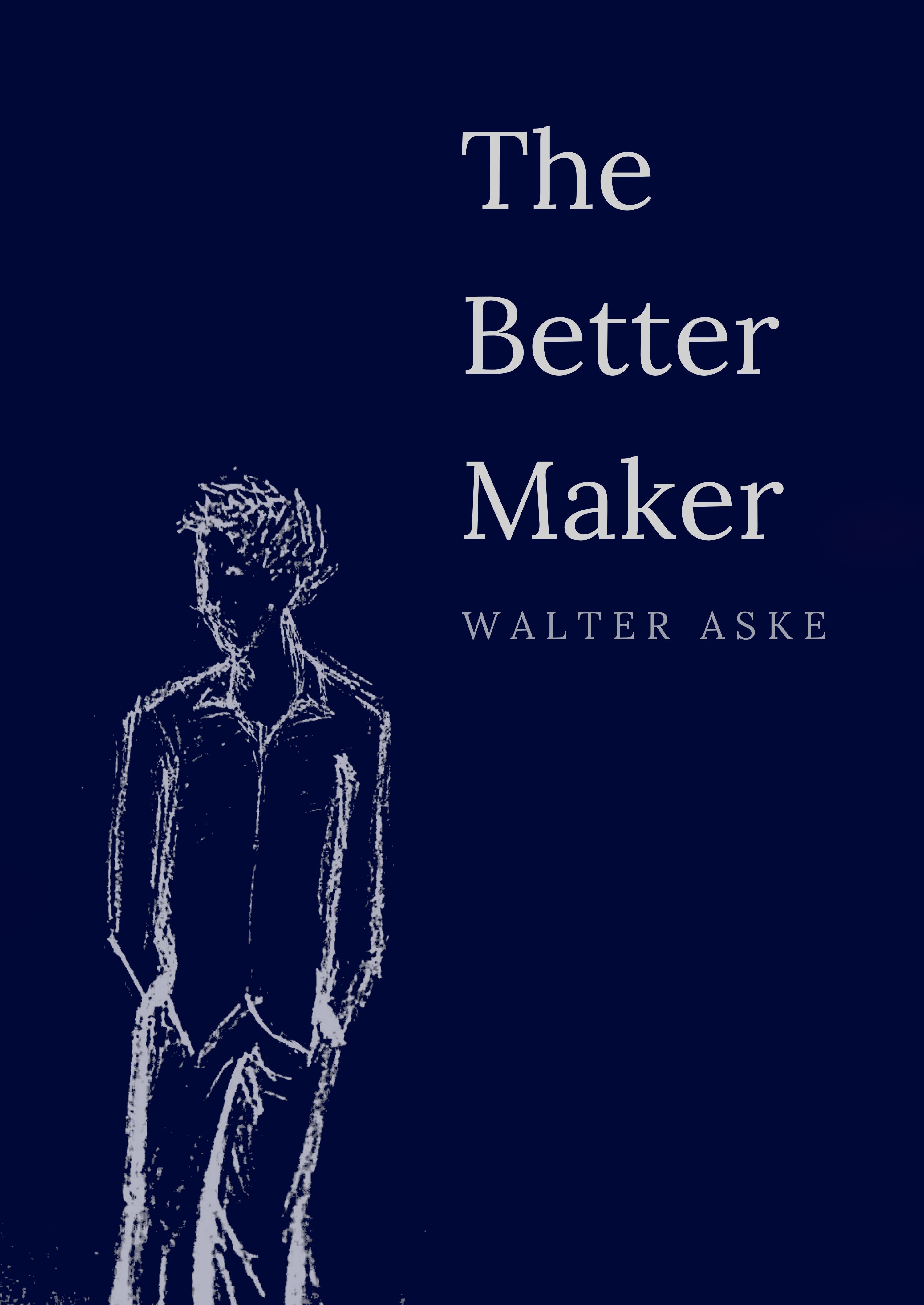
The Better Maker, by Walter Aske
a review

A couple of preliminary notes and disclaimers. First, I helped Walter with the cover. Second, we were writing to each other and talking about it (and other things) as he revised it for publication. Still, my contributions were minimal, and mostly I offered encouragement. The other thing is that this book ended up being one catalyst for writing my last book. So it’s hard to be completely objective for all these reasons (but who wants that anyway). I tried to keep spoilers to a minimum, and in particular I said almost nothing about what I think is the real heart of the book, as I think it’s sweet to discover it, as I did.
*
When I started reading The Better Maker I thought it would be mainly a character book, meaning, the plot really wasn’t the point, but this ended up not being the case. It follows Patrick, a lost young man suffering through college and the perils of falling in love, in particular struggling through an obsession with an unattainable girl. Too high brow in literary tastes, too gloomy and pessimistic in demeanor, too lost and aimless in goals, Patrick is a stand in for every intelligent young man growing up in the twilight of western civilization. I could immediately relate.
The story jumps back and forth between the college days and a few years later, when Patrick is, half involuntarily, in exile. Down and out, is another way to put it. We as readers know things in advance that college Patrick doesn’t. In theory this would give more detachment but somehow it feels like the opposite. We know the university experience ended in failure, and that his obsession with the almost too good to be true Polly remains (she is almost too good to be true, obviously, because she is seen through the partial eyes of infatuation). We have to keep reading to figure out why, though in truth we never do, because it makes no sense. Slowly, the plot does thicken, and it’s not just a random collection of college life episodes and reminiscences. There are unexpected twists and, more importantly, while Patrick only learns it too late, the focus of the book and of his life actually does change, and there is always a sense that he is taking the wrong course, making the wrong decision (as one does, when young). This book really is a slow motion train wreck. We suspect from the start that nothing good will come out of his actions either in the past or in the future, though at the same time it is the classic existential drama of one’s life being dictated by a myriad forces beyond our control or understanding. Also, the college setting, especially, has an almost dystopian atmosphere, which I could relate to as well.
In the background, and the foreground at times, there is the degradation of university and intellectual life, the take over of it by middle managers or ideologues (or both at the same time), and an almost apocalyptic feel that there is no way out for a sensitive young man in this age. Patrick will always be defeated one way or another. It’s also hard to sympathize with him at times, but mostly because he surrounds himself with very unsavory friends, perhaps to diminish his solitude. As the book keeps going, he no longer has a choice, it seems. Especially the character of the Viking, which is very absurd but somewhat realistic, just becomes worse and worse and you just want him to go away or maybe die. His quirks which start out as annoying and comical become more and more vile and disgusting and unnerving (but this too, eventually, contributes to the plot, though you don’t expect it).
There is a lot of humor, wonderful bits of prose and not an insignificant amount of, somewhat disguised, social commentary. This last bit is more made of winks than statements, and it probably is better that way. If you know what it’s pointing to, you will nod in agreement. It’s also full of witty and precise observations about things, and conversations that are improved reality. A few examples:
He sits through the first few lectures in an agony of boredom. The lecturers justifiably assume complete ignorance in their audience. After a week of tedious plot summaries, surrounded by manically scribbling robot people, he quits lectures for good.
“- If you do not eat, your brain won’t be able to think, and then
- I’ll be like any other English student. Only thinner.”
“Each university year has its own atmosphere, the third being the season of imminent endings as those with degrees in English, Music, Philosophy, realise they will soon be unemployable.”
“His time in Italy is soon over. About another fortnight, in this cemetery of mammocked mosquitoes - spattered on the walls where he smashed them with his palm or Inferno or a shoe: at least forty, some just mangled legs, others a nice bloodstain, his blood, the beginning of a prehistoric cave painting, of the hunt. When he goes, will Concetta scrape them off the walls? Or just paint over? Perhaps what seems solid wall is a decade of insect biomass; perhaps the entire building, perhaps the whole of Italy, is nothing but encrusted mosquito bodies, and English blood.”
Yet, to me, the centerpiece of the whole thing is Patrick’s relation to Sini, which I refuse to spoil by talking too much about. In its own weird way it’s a beautiful love story, and heart warming, and heart breaking. This relationship is where the soul of the book lies, and I think the author knows it, but keeps trying to hide it from us. As it goes on, and the trainwreck we’ve been expecting comes closer (on both timelines, college and post-college), it gets more intense, and darker, and sadder.
In the end the book will break your heart several times (if you have one), and though you will feel like Patrick’s years were mostly wasted, you won’t feel like your time reading about them was.
*
Man, thanks, you really read it with a discerning mind, you saw aspects I barely even considered. A good reader is always a great blessing, so many thanks.