
about life and death
rejoinders and such


.
these three posts by Bruce are all great and provoked a lot of thinking. the first one might seem unrelated, but is not completely so in my thoughts, since it is about very specific aspects of human creativity, their very texture and flavor, so to speak; and the question, in relation to the other posts, is if these very specific things about this life are, after all, significant on their own, or if when all is said and done they are pretty much pointless when we contemplate beyond this life; either way it is a great read.
.
if God cannot control every circumstance of a person’s life, and it’s obviously true that he cannot even if he wanted to (which i doubt he would), then there is no reason to believe he can ensure one’s birth (no more than one’s life) has ideal circumstances. because our birth obviously depends on other people’s lives, which cannot be completely controlled. (even if one believed, and i don’t, that the body, and thus family, nation, etc, a person incarnates into is arbitrary, it would still be the case).
in fact, if pursued enough, every single birth is an endless chain of dependencies and unpredictable circumstances. so, as always, our freedom is exercised against both an uncertain future and a set of givens; before, during and after incarnation on this earth. and so, the specific circumstances of our birth are not necessarily the best for God’s purposes and desires for us.
God can navigate the changing waters of a universe of free beings, but he cannot control the tides and the winds. (Walter Aske wrote something like this to me in an email and it stuck with me as a good image; although in his version it was Man, not God, navigating the waters, and the structure of the sentence was reversed, so that it reads more optimistically for both reasons; but as you know, i think God and Man are not that different in essence, the latter is merely a less advanced version of the former).
(God has a God of his own, is an encapsulation of this part of my metaphysics; i have since decided that this eternal regression must be admitted if one is to also believe in eternal progression; the alternative of course, is a lone God of perfect stasis at the origin, and the same at the end; again Jesus is a great example, since we know him as a God, and he himself said he had a God).
.
Bruce’s post about attitudes to death put into words precisely how i’ve always felt about the matter but never was able to grasp so succinctly and clearly.
(i talked before about coming to believe in God and other such transitions in thought and feeling and Loup mentioned in one that i was lucky, since my rejection of atheism came from joy and curiosity, rather than grief. but as i said to him at the time, this is not entirely true. in fact, i credit my birth into my own mind, primarily, to the events of two deaths in my family, two very close deaths, when i was eleven. before that i was a weird kid. after experiencing it, i knew i was a weird kid. and since then, i have been more or less obsessed with death; there must be a better way to say this, but i can’t find it at the moment; obsessed with death sounds right enough, if a little dark; and this, i suppose, makes me a weird adult, but at least i know it)
the implications of death, and of the sadness of death despite it being a levelling up (or rather precisely because of it, as Bruce says, and giving other examples from this life, which is always a fundamental step for me in these matters), testify to the significance of life, and imply that it’s not just our decision to incarnate and experience (any experience of) death that matters for heaven.
rather, our experience of life, itself, with everything it has, both good and bad, is fundamental. if not for everyone, for the vast majority of people (anomalies always exist, but they affirm the norm).
this despite the fact that, as Bruce says, most people, most incarnations, end in death way too early. i don’t think the prevalence necessarily makes it more significant. if anything, the opposite. value is found in scarcity, in incarnations as well as in currency and lovers and everything else.
and because God cannot cause every birth to be in ideal conditions, it is not a given that incarnations that end in the womb, for example, are ideal either, or even sufficient, for the specific being to choose heaven and the specific purposes God has in mind as best for them.
if anything, the fact that we are naturally sadder at the death of a child than at the death of an old man suggests to me that there is something intrinsically valuable about the experiences of this life, both of joy and of grief (and these require a moderately long life, perhaps until full adulthood).
.
this is a very grim and distasteful thought (i started writing a story about it but quit, because it was so horrible), but it’s one i think is possible: it seems likely to me that the initial experience of incarnation is very extreme and can be very thrilling to disembodied spirits (like a near death experience is for someone alive). thus some human spirits might choose to do it knowing in advance that they will not, and wishing they will not, live a full life, but only for that high (much like some people seek near death experiences without wanting to actually die fully in the end). this could help explain the prevalence mentioned above without emptying the experience of life of meaning.
.
Fridolin Jetzer made a great comment on the entropy post:
“crucially important, for those of us who live out full lives in the Primary Creation, that the metaphysical explanations we adopt insist upon the continuing relevance of the particularity of those lives, the acts we perform, and the relationships with other Beings we form for the Second Creation.”
this is my main preoccupation in all matters theology and metaphysics. any explanation of the before and after and outside must not empty of meaning the here and now and inside.
clearly this is a very hard task, if we look into any metaphysics; from the completely atheist to the most pluralist theism (which are, i believe, the two ends of the spectrum). it’s likely the biggest trap in this kind of speculation.
of course, one way to do it is to reject consistency and coherence between the different parts of one’s worldview. but i cannot live like that. i think it’s wise to seek coherence in all things (even knowing it will always be incomplete, because things are always changing everywhere). this is also why i like bread, and hate porridge. both the physical and the metaphysical versions.
.
on the post about entropy Bruce talks about how the resurrection might mean that, instead of being made from other beings, as is the case here, we will be made solely from ourselves, thus ending the servitude of beings to beings which is necessary in this life.
perhaps it’s best to think (even here, and more so in heaven) in terms of service, rather than servitude. although the two words have the same root and used to mean the same, their meanings have diverged and are almost opposite now. i believe this is due to Jesus’ incarnation and resurrection; he turned servitude on its head, a king washing the feet of his servants. thus even kingship, headship is shown to be about service, always. everything is, really. because reality is people. from the grain of salt to the full ocean, it’s all people. very different kinds of people, sure, but always some kind of people.
.
the idea of resurrected life being made only from oneself rejects ex nihilo or ex deo creation at the origin of the world, but places it in each individual afterlife. but it doesn’t make sense there either for the same reasons.
all we know about creation and beings is about rearrangement, and mutual interpenetration and cooperation (or its opposite, enmity; but either way, intercourse).
(of course, it’s also a metaphysical position that one can in fact not learn anything about heaven from the dynamics of this life; but i do not share it).
by definition a world is one of interactions and interpenetrations, not of unconnected bits living only from themselves. and we make each other not just physically. we are made of other people in all ways. whenever we are more than an individual core, pure spirit, we are also family and friends and spouses and everyone we meet, in varying degrees of familiarity and interconnection. but also every other experience. books we read. food we eat. music we listen to. clothes we wear. sights we see. thoughts we think.
so, if it is the case that heaven will cease to have this fundamental component of existence, of service and sharing and interpenetration, then it will have no friendship, and no food, and no talk, and no books, and no music, and no communion whatsoever. since all those things, and all the things that are required for those things, must now be made ‘from themselves’. but what is a book or a violin if not a tree, with thread from this other plant, and strings from the gut of this animal, and so on for everything else, really. we ourselves are not that different from a book or a violin. we have more water, perhaps. but water too is alive. perhaps we have more thoughts, and memories; or more specific ones. but the more specific, the more they are full of other beings, and cannot be separate from them.
perhaps you think the psychic component is not as relevant as the physical, but our taxing of other being’s potential and energy happens there too, and in so many different ways. so the same exact rule must apply there. and it cannot be said that in heaven we will ‘think’ of a meal, or of a person, but they won’t be drained by the experience, as they are here. in fact, since our thinking will also be more powerful in the resurrection, then also the effects of our thinking on whatever we think of.
in such a scheme, they also won’t be nourished, or improved either. but this is the other side of it; we can drain, but we can also nourish, and largely both at once; a servant, after all, always receives some kind of pay; and while there is slavery in this life, because there are evil intents, heaven i imagine as excluding those who have such evil intents at their core, and that is its peculiarity, above all; it cannot exclude failure in action, however, because to exclude failure is to exclude freedom; thus there is almost guaranteed to exist some kind of pain, and discomfort, and death, and so on, even in heaven; these are indissociable from the very concept of change; but cruelty and viciousness can be excluded without implying stasis; if anything, these evil intents tend towards stasis because they tend towards dissolution, rather than coherence; and coherence is dynamic, a balancing act, precisely because of the reality of change.
thus the idea that this life and its particularities, its very structure, are pointless beyond the decision to choose an existence in heaven where we are made only from ourselves doesn’t make sense to me.
if nothing else because it is despair inducing. it makes more sense, and is simpler, that heaven is merely a place where these relations, which are necessary for any kind of existence beyond pure spirit, are voluntary and conscious, and that life as it is actually has some relation to how we will live in heaven.
an existence where we are made solely of ourselves is a diminished experience. this was, in fact, the original experience, when we were only spirits. we have gained more layers since then. the purpose might not be to shed them, as is said by vedic and other such philosophies, but rather to clean them. this symbolism is more in line with the way of thinking of Jesus and the authors of the bible.
it makes more sense to me that in heaven we become parts of each other from a conscious and loving place; not with coercion, manipulation or abandon; whereas here, even among human beings, we rarely achieve this completely and never consistently, and much less so with other forms of life (who really thinks about the soul of a cabbage when they eat it, or of an instrument when they play it. i try to, but i don’t do it as often as i should, and i’m pretty sure i don’t do it perfectly; and on and on for every other being in every other situation).
(perhaps we will be able to do this after we die because, largely, these thoughts and relations are about things that have died and lived again, since this is actually the fundamental pattern found in life; one thing is another thing reborn in another form; a violin is a sort of reborn tree, for example; we may have to experience physical death to be able to fully relate to other things that have experienced it already, like a tree turned violin; or even a seed, turned tree).
heaven, being a place of love, does not negate the necessity and benefit of being partly made from other beings (since this is, i believe, inherent in the very concept of a body, and thus for every existing world that is anything more than pure spirit). but heaven makes it explicit and voluntary (that is, we will make each other out of conscious love for each other).
i cannot even begin to imagine what an eternal incarnation might be without any reference to this incarnate life either, except as a static contemplation, indistinguishable from a life as pure spirit, rather than as a complete being.
.
one rule i follow about metaphysics is: if the idea or its implications are despair inducing (as the emptying of this life of meaning is, to me), then i reject it. i regard despair and meaninglessness as foolish, from the outset. if one regards despair as intelligent, that too implies that life is meaningless.
so i always believe that some other, non despair inducing and non meaningless explanation must be available.
but avoiding despair cannot entail lying to ourselves about the horrors and tragedies of this life, and embracing any explanation that ignores the obvious reality of horror, tragedy and absurdity in this life. this too, is a path to meaninglessness.
incarnate life on this earth is good and bad. and both of those things must mean something. that is my fundamental metaphysical position.
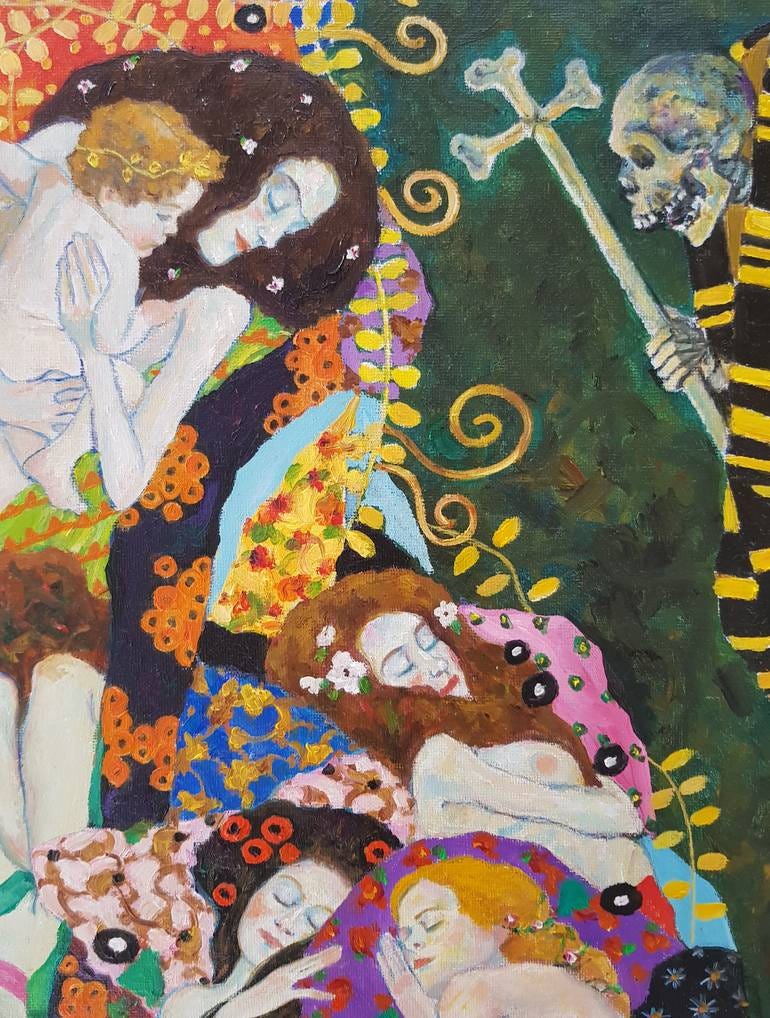
Great follow-up, Laeth. First-time commenter; longtime reader. Pardon the length of my comment…
I appreciate that you grouped Bruce’s “Magic of Analogue” post along with the others. I have long been of the conviction that true artistry depends upon a love of the material. And since whatever material the artist uses comes from another Being and is lent for the purpose, the artist via his artistry can be said to love this other Being. The tree yearns to lend itself to the use of a violin, the cabbage longs to be savored, etc. I think I first encountered this idea when I was young reading a story about the tree that lent its wood to be shaped into the cross. To bear Christ was glory to this tree. I have come across this theme in the music of the contemporary English folk group “The Longest Johns.” The blacksmith in their song “Hammer and the Anvil” only makes something with the consent of the hammer and the anvil:
--
"I thought to make a horseshoe, and asked my hammer thus
He said "I'll ask the anvil what you require of us"
The hammer asked the anvil, and she at once agreed
That they should meet together in the way that I decreed"
--
It was through the Johns that I first learned of Rudyard Kipling’s magnificent poem “A Tree Song” or “Oak and Ash and Thorn.” I love how Kipling gets across the idea of what material culture truly is, namely a record of the relationships between a nation of men and the Beings which comprise their environment. And some of these relations are not cordial. The elm in particular is singled out:
--
"Ellum she hateth mankind, and waiteth
Till every gust be laid,
To drop a limb on the head of him
That anyway trusts her shade:"
--
I believe Bruce put it somewhere in his voluminous writings that what we call luck and chance are the products of Beings. Kipling’s fickle elm is a great example of that. Or Tolkien's Old Man Willow.
On another note, Bruce has talked before about how the love someone has for another person might influence their decision to join the Second Creation. Similarly, might it be that the love of an artist for his material, or the gourmand for his cabbage, might influence that Being to choose “redemption” as it were and incarnate in the Second Creation?
Links to the songs I referenced:
Hammer and the Anvil: https://www.youtube.com/watch?v=YGn7XgbBVms
Oak and Ash and Thorn: https://www.youtube.com/watch?v=mr1CM_yw68c